Welcome to our Blog page.

Our efforts to keep you up to speed on all things real estate related in our area.

Much of the information shared here is researched and confirmed through reliable industry sources, paired with my own professional insight and perspective. That said, this blog is meant to inform — not replace advice from legal, financial, or lending professionals.

Every real estate situation is unique. If you’d like to talk through your specific circumstances or get guidance tailored to your goals, I’m always happy to have that conversation.

Sept. 7, 2026

Lake Hartwell Water Levels

Lake Hartwell Water Levels: What It Means for Lake Living & Real Estate

If you live around Lake Hartwell, own property here, spend your weekends on the water, or have been thinking about buying a lake house, you've probably heard the news.

The U.S. Army Corps of Engineers is putting new restrictions on how high Lake Hartwell can rise — and those restrictions could remain in place for several years while a permanent engineering solution is developed.

That's a big deal.

But before anybody starts thinking "What does this mean for Lake Hartwell?" or "Is waterfront property going to be a problem?", let's take a breath and look at what is actually happening.

Because there is some legitimate concern here.

There is also a lot that is still very good about Lake Hartwell.

And if you're thinking about buying or selling real estate around the lake, I believe there are some things you need to understand before making a decision.

What Is Happening With Lake Hartwell Water Levels?

On August 26, 2026, the U.S. Army Corps of Engineers' Savannah District announced that it will maintain lake-level restrictions at Hartwell Lake until a long-term engineering solution can be designed and constructed to address seepage concerns at the Clemson Lower Diversion Dam Saddle Dike.

The important part first:

USACE says there is no immediate danger to the public.

The issue has been monitored since 2015. More recent engineering evaluations, including observations following significant storms, have shown that the seepage and erosion concerns are worsening. The Corps is taking action now to reduce pressure on the structure while a permanent solution is developed.

So this isn't a situation where the Army Corps suddenly discovered a dam is about to fail tomorrow.

It is a dam-safety issue that is being proactively addressed.

And that's an important distinction.


How Low Will Lake Hartwell Be?

This is probably the question I'm hearing the most.

Historically, Lake Hartwell's normal summer full-pool elevation has been around 660 feet above mean sea level.

Under the new interim restriction, the Army Corps is lowering the lake's normal operating guide curve to 656 feet MSL year-round.

The Corps will also maintain a maximum lake elevation of 662 feet MSL during the restriction period.

In plain English:

The lake is going to be managed lower than the traditional summer full pool.

That's significant.

But there is another important piece of information that can get lost in the headlines.

Lake Hartwell is already very low because of current drought conditions. The Army Corps says the lake is currently below the new 656-foot guide curve, meaning there isn't an immediate recreational change simply because this restriction was announced.

The bigger change comes when rainfall returns and the lake begins filling again.

Instead of eventually returning to its historical 660-foot summer full pool, the new interim guide curve will target 656 feet year-round.


Why Is the Army Corps Lowering Lake Hartwell?

The reason comes down to pressure on the Clemson Saddle Dike.

According to the Army Corps, water has been seeping through and underneath portions of the earthen structure. That seepage can carry material with it, gradually creating erosion paths through the structure.

Lowering the lake reduces the amount of water pressure against the dike.

That gives engineers time to study the problem, monitor the structure and develop a permanent solution.

The Army Corps plans to initiate a formal Dam Safety Modification Study.

USACE says those studies can take up to two years, and that design, funding approval and physical construction can take another five years or more. The Lake Hartwell Association describes the overall process as potentially five to ten years.

So when you hear people say:

"Lake Hartwell is going to stay low for 10 years."

That's a little too definitive.

A better way to say it is:

Lake Hartwell could operate under these restrictions for years, potentially approaching a decade, while a permanent solution is designed and constructed.

That's what we actually know right now.


Is Lake Hartwell Going Away?

No.

And I think this needs to be said because social media has a way of taking complicated situations and turning them into scary headlines.

Lake Hartwell isn't going away.

Boating isn't going away.

Fishing isn't going away.

Swimming isn't going away.

The lake isn't being closed.

And waterfront real estate isn't suddenly worthless.

The Army Corps is actually taking these measures because it wants to protect the surrounding communities and the lake infrastructure while a permanent solution is developed.

There will absolutely be impacts.

But there's a big difference between "Lake Hartwell is changing" and "Lake Hartwell is in trouble and shouldn't be invested in."

Those are two very different statements.


Let's Remember What Lake Hartwell Actually Is

Sometimes a major news story makes us forget the bigger picture.

Lake Hartwell is one of the Southeast's largest and most popular public recreation lakes.

At full summer pool, the lake covers nearly 56,000 acres and has approximately 962 miles of shoreline.

It stretches through both South Carolina and Georgia and touches six counties — Anderson, Oconee and Pickens in South Carolina and Hart, Franklin and Stephens in Georgia.

Interstate 85 crosses the lake, making it incredibly accessible from Greenville, Atlanta and the surrounding Upstate communities.

And this isn't just a lake people look at.

People live here.

They boat here.

They fish here.

They camp here.

They swim here.

They spend summers here.

They retire here.

They build second homes here.

They raise families here.

And thousands of people make their living around this lake.

The Army Corps describes Hartwell as one of the most visited Corps lakes in the country, with millions of people using its parks, marinas and campgrounds each year.

That's a pretty strong foundation.


The Good Stuff About Living on Lake Hartwell

If you're considering buying a home on Lake Hartwell, don't let the current headlines make you forget why people want to live here in the first place.

The size is incredible.

Nearly 56,000 acres of water gives you a lot of lake to explore.

Hartwell stretches for miles up both the Tugaloo and Seneca Rivers, with nearly 1,000 miles of shoreline.

That creates all kinds of different lake environments — deep-water areas, coves, larger open-water properties, quieter pockets and communities with very different personalities.

Boating is a way of life.

Whether you're into fishing boats, pontoons, wake boats, kayaks or simply cruising around on a Saturday afternoon, Hartwell offers an enormous amount of water to explore.

Fishing is fantastic.

Hartwell is known for largemouth bass, striped bass, hybrid bass, crappie, catfish and bream.

For a lot of people, "lake living" starts with a fishing rod.

Clemson is right here.

That's another huge advantage.

Lake Hartwell isn't some isolated lake in the middle of nowhere.

You've got Clemson University, Clemson, Seneca, Anderson and the surrounding Upstate communities all connected to the lake.

For buyers who want waterfront living without giving up access to restaurants, healthcare, shopping, college sports and everyday conveniences, that's a pretty compelling combination.

And then there's the access.

The Army Corps maintains numerous recreation areas, boat ramps, campgrounds and public access points around Hartwell.

That's important because you don't necessarily have to own a boat — or even own waterfront property — to enjoy the lake.


So What Does This Mean for Lake Hartwell Real Estate?

This is where things get interesting.

And I'm going to be careful here.

I don't think anybody can honestly tell you today exactly what the new lake-level restrictions will do to Lake Hartwell property values over the next five or ten years.

We simply don't have enough market data yet.

Anybody giving you a guaranteed answer is guessing.

What I do believe is that buyers and sellers are going to pay more attention to the specifics of individual properties.

And that's actually a good thing.


Not All Lake Hartwell Waterfront Property Is the Same

This has always been true.

But the new water-level restrictions make it even more important.

If you're buying a lake house, you shouldn't simply ask:

"Is this property on Lake Hartwell?"

You should be asking:

  • What is the water depth at the dock?
  • What is the water depth in front of the property?
  • How does the property perform at lower lake levels?
  • Is the property located in a deep-water cove?
  • What type of dock does it have?
  • What are the current dock permits and restrictions?
  • How does the shoreline change as the lake drops?
  • Is the dock usable at lower elevations?
  • What does the property look like when the lake is below full pool?
  • Is there adequate access for boats?
  • What are the topography and shoreline characteristics?
  • Are there septic considerations?
  • Are there easements or other restrictions that affect the property?

Those questions matter.

And they're questions I would encourage every buyer to ask before falling in love with the house.


What About Existing Lake Hartwell Homeowners?

If you already own property on Lake Hartwell, don't panic.

But do pay attention.

If your dock, shoreline or boating access is important to you, understand how your specific property performs at different lake elevations.

A four-foot difference in lake level doesn't affect every property the same way.

One property may still have excellent water access.

Another may have a shallow cove.

Another may have a steep shoreline with plenty of depth.

Another may have a dock that becomes much less useful at lower elevations.

The lake is one thing. Your piece of the lake is another.

That's why local knowledge and property-specific due diligence are so important.


What About Selling a Lake Hartwell Home?

If you're selling a waterfront property right now, I wouldn't recommend ignoring the issue.

I'd recommend addressing it head-on.

Buyers are going to ask questions.

Instead of pretending the water-level restrictions don't exist, give buyers the information they need to understand your property.

Show them the shoreline.

Show them the dock.

Talk about water depth.

Explain the cove.

Explain the access.

And most importantly, price the property based on the current market — not on what the property might have been worth at the absolute top of the market several years ago.

The best lake properties will still attract attention.

But buyers are becoming more educated, and they're going to be looking much harder at the details.


Does This Mean You Shouldn't Buy Lake Hartwell Real Estate?

That's not the conclusion I'd draw.

If anything, I think it means you need to be a smarter buyer.

Lake Hartwell remains an enormous recreational resource with an incredible location, tremendous shoreline, established communities and decades of history as one of the most popular lakes in the Southeast.

The current restriction is a legitimate issue.

But it's also an issue that is being actively addressed by the agency responsible for managing the lake.

And the goal is ultimately to protect the lake, the surrounding communities and the people who live here.

The right question isn't necessarily:

"Should I buy Lake Hartwell real estate?"

The better question is:

"Which Lake Hartwell property makes sense for me under the conditions we know today?"

That's a much better question.


If You're Thinking About Buying on Lake Hartwell...

This is where I think having someone who understands the local market can make a real difference.

I work with buyers and sellers throughout the Western Upstate, including Anderson, Oconee and Pickens counties, Clemson, Seneca and the communities surrounding Lake Hartwell.

When you're looking at lake property, you're not just buying a house.

You're buying:

The house.
The land.
The shoreline.
The water access.
The dock.
The location.
And the lifestyle.

All of those pieces need to make sense together.

I've put together a dedicated resource for buyers and sellers interested in Lake Hartwell real estate where you can search available properties and learn more about the area:

Explore Lake Hartwell Real Estate →
Lake Hartwell Homes for Sale


I Also Recorded a Quick Video About the Lake-Level Changes

I've put together a short video discussing the Lake Hartwell water-level situation and what this could mean for the lake and the surrounding area.

Watch the video here:
Lake Hartwell Water Level Update on YouTube


My Take

I've spent a lot of time around Lake Hartwell, and I think it's important to separate legitimate concerns from unnecessary panic.

The water-level restriction is real.

The engineering issue is real.

The potential timeline is long.

And there will be impacts on recreation, businesses and some waterfront properties.

But Lake Hartwell is still 56,000 acres of opportunity, recreation and some of the best lake living you'll find anywhere in the Upstate.

I don't think this story should make people run away from Lake Hartwell.

I think it should make buyers more educated and sellers more transparent.

If you're thinking about buying or selling a Lake Hartwell property, I'd be happy to talk through what the new restrictions could mean for your particular situation.

No sales pitch. No pressure.

Just an honest conversation about the property, the lake and the market.

— Robert Whitesides
The Go-To Group at Agent Group Realty


A Note About the Information in This Article

The information in this article is based primarily on information published by the U.S. Army Corps of Engineers, Savannah District, along with information from the Lake Hartwell Association and other public resources. The Army Corps states that there is currently no immediate danger to the public, while also stating that the Clemson Saddle Dike requires action and that lake-level restrictions will remain until a permanent solution is developed and constructed.

Lake levels, operating procedures, engineering plans and timelines can change. Information about a particular property, including docks, water depth, shoreline conditions, permits, septic systems, flood considerations and other property-specific issues should be independently verified before making a real estate decision.


This article is for informational purposes only and is not engineering, environmental, legal or financial advice.

Posted in Market Updates
Aug. 25, 2026

Is the Real Estate Market Dead? A Look at the 2026 Housing Market in Upstate South Carolina

Is the Real Estate Market Dead?

If you've talked to enough people about real estate lately, you've probably heard some version of it:

"The market is dead."

"Nobody is buying."

"Everything is frozen."

"I'm just going to wait until things get better."

I understand where those comments are coming from.

The 2026 housing market has been frustrating for buyers, sellers, real estate professionals, builders and lenders alike. Mortgage rates remain elevated, affordability is difficult, homes are taking longer to sell, and buyers have become much more selective.

But here's the important distinction:

The real estate market isn't dead. It's slower, more expensive to finance, and much more negotiable than it was a few years ago.

And that's a very different story.

As a REALTOR® working every day in the Western Upstate of South Carolina, I believe it's important to look at the actual numbers—not the headlines.


The 2026 Housing Market Is Definitely Slower

Let's start by acknowledging the obvious.

This is not a booming housing market.

The National Association of REALTORS® reported that existing-home sales in July 2026 were running at a seasonally adjusted annual rate of 4.06 million, down 1.7% from June but still 0.7% higher than July 2025.

The median existing single-family home price was $440,300, up 1.9% from a year earlier.

There were approximately 1.54 million homes in inventory, representing about 4.6 months of supply.

So are fewer people buying homes?

Yes.

Are people still buying homes?

Absolutely.

That's an important distinction.


Mortgage Rates Are Still a Big Part of the Story

It's difficult to talk about the current housing market without talking about interest rates.

As of August 20, 2026, Freddie Mac's Primary Mortgage Market Survey showed the average 30-year fixed mortgage rate at 6.65%.

That's down slightly from 6.67% the previous week—but still considerably higher than the rates many homeowners locked in during 2020–2021.

This creates a problem that didn't exist in quite the same way during the last housing cycle.

Millions of homeowners have mortgages with historically low interest rates.

If they sell, they may be giving up a 3% or 4% mortgage and replacing it with something closer to today's 6%–7% environment.

That's one reason inventory and transaction volume can remain constrained even when there are plenty of people who would like to move.


What We're Seeing in the Western Upstate

Now let's bring this home.

Because South Carolina isn't the United States, and Greenville isn't Oconee County.

The Western Upstate has its own story.

The latest county-level data from Realtor.com shows just how different the individual markets can be.

Oconee County

As of the latest available county market report, Oconee County had a median listing price of approximately $457,950 and a median sold price of $438,500.

The median days on market was 58 days, up 6.86% year over year.

Interestingly, the median sold price was reported 15.55% higher than the prior year, while homes sold for approximately 98% of asking price on average.

That's not a dead market.

That's a market where buyers have negotiating power.

Pickens County

Pickens County showed a median listing price around $422,393 and a median sold price of $318,000.

The county had approximately 1,155 homes for sale, with median days on market around 57 days.

Homes sold for approximately 99% of asking price, and the county was characterized as a balanced market.

Again—slow?

Yes.

Dead?

No.

Anderson County

Anderson County's latest available data shows a median listing price around $349,000, with approximately 2,100 homes available.

The median sold price was about $299,995, and the median days on market was 52 days in the June report. More recent August data shows average days on market around 64 days.

That tells me buyers are taking their time.

They're negotiating.

They're shopping.

But they're still buying.

Greenville County

Greenville County remains one of the largest and most active housing markets in our region.

August 2026 data shows approximately 4,884 active listings, with median days on market around 57 days.

Inventory was up 11.12% year over year, while the median listing price was approximately $412,425.

The median sold price was about $370,000, down 2.61% from the previous year.

That's a cooling market.

It isn't a collapse.


This Is NOT 2008

This is probably the most important part of this article.

I was in the real estate business during the last major housing crisis, and what we're experiencing today is fundamentally different from what happened between 2008 and 2011.

The distinction matters.

In 2008, housing was part of the problem.

Today, housing is largely dealing with an affordability and transaction problem.

During the financial crisis, loose mortgage underwriting, risky mortgage products, rapidly rising defaults and foreclosures helped create a massive supply of distressed properties.

The Federal Reserve documented how declining home prices and loosened underwriting standards contributed to sharp increases in mortgage delinquencies and foreclosures.

Research from the National Bureau of Economic Research also documented the enormous role that foreclosures played in the housing downturn.

And the national home-price data shows just how severe that correction was.

The S&P Cotality Case-Shiller national index peaked around 184.6 in July 2006.

By early 2012, it had fallen to approximately 134.

That's roughly a 27% decline from the peak to the trough in the national index.

That's a housing crash.

What we're experiencing today doesn't look like that.


Today's Homeowner Is In a Very Different Position

One of the biggest differences is homeowner equity.

Many homeowners today have substantial equity in their properties because of the appreciation we've experienced over the last decade.

The Federal Reserve Bank of New York reported approximately $13.1 trillion in U.S. mortgage balances at the end of Q2 2026, while overall household debt remained relatively stable.

And mortgage delinquency remains nowhere near the kind of systemic crisis associated with 2008.

The Federal Reserve's latest data shows the delinquency rate on single-family residential mortgages held by commercial banks at approximately 1.86% in Q2 2026.

That doesn't mean every homeowner is financially comfortable.

It certainly doesn't mean there aren't people struggling.

But it does mean we're not looking at the same broad-based mortgage distress that helped fuel the 2008 housing collapse.


So Why Does the Market FEEL Frozen?

This is where I think the word "frozen" actually makes some sense.

The market has become a transactional traffic jam.

Think about it.

A homeowner has a 3.25% mortgage.

They'd like to move.

But replacing that mortgage with a 6.65% mortgage may dramatically increase their monthly payment.

So they stay put.

A buyer wants to purchase.

But that buyer is struggling with affordability at today's prices and interest rates.

So they wait.

The seller doesn't want to reduce the price.

The buyer doesn't want to overpay.

And the transaction doesn't happen.

That's a frozen market.

But frozen doesn't mean broken.


Real Estate Has Always Had Ups and Downs

This is something I remind my clients often:

Real estate has never gone straight up.

There have always been cycles.

Booms.

Corrections.

Recessions.

Interest-rate changes.

Inventory shortages.

Overbuilding.

Underbuilding.

Economic expansions.

Economic contractions.

And yet, over long periods of time, residential real estate has historically appreciated.

The FHFA House Price Index provides some pretty compelling perspective.

As of Q2 2026, South Carolina's FHFA purchase-only house price index was:

  • Up 2.38% over one year
  • Up 45.39% over five years
  • Up approximately 350% since 1991

The national FHFA index was up approximately 335.69% since 1991.

That doesn't mean every house appreciates every year.

It doesn't mean you can't lose money on real estate.

And it certainly doesn't mean you should buy a property simply because "real estate always goes up."

But it does demonstrate something important:

Historically, time has been one of the most powerful advantages a homeowner can have.


What Does This Mean for Buyers?

If you're a buyer in today's market, there are actually some opportunities that didn't exist during the frenzy of 2020–2022.

You may have:

  • More homes to choose from
  • More time to make a decision
  • More negotiating leverage
  • More opportunity to request repairs
  • More opportunity to negotiate price
  • Less pressure to waive important contingencies

That's meaningful.

The tradeoff?

Money is still expensive to borrow.

So buyers need to focus less on predicting the absolute bottom of the market and more on whether the specific property, payment and long-term plan make sense.


What Does This Mean for Sellers?

Sellers have a different challenge.

The days of putting a house on the MLS on Friday and having 15 offers by Sunday are not the norm in today's market.

Pricing matters.

Condition matters.

Presentation matters.

Marketing matters.

And patience matters.

If you're selling in Oconee County, Pickens County, Anderson County, Greenville County, Seneca, Clemson, Lake Keowee or Lake Hartwell, your strategy needs to reflect what buyers are actually doing—not what they were doing three years ago.


The Western Upstate Is Still a Special Place to Own Real Estate

There's another piece of the equation that I don't think we should overlook.

People aren't moving to the Western Upstate simply because of a spreadsheet.

They're moving here because of the lifestyle.

Lake Keowee.

Lake Hartwell.

Lake Jocassee.

The Blue Ridge Mountains.

Clemson University.

Outdoor recreation.

Healthcare.

Small-town communities.

Greenville's growth.

And the quality of life throughout Oconee, Pickens and Anderson Counties.

South Carolina's population has grown significantly since 2020. Census estimates show the state population increased approximately 8.8% from April 2020 through July 2025.

That underlying population growth is one of the reasons I remain optimistic about the long-term fundamentals of this part of South Carolina.


My Take as a Western Upstate REALTOR®

I'll be the first to tell you:

This isn't the easiest real estate market I've ever worked in.

It's not.

But I also don't believe the sky is falling.

I believe we're in a period of normalization.

The market is forcing buyers and sellers to have more realistic conversations.

Sellers can't simply name a price and expect the market to validate it.

Buyers can't assume every property is going to be 20% below asking price.

And REALTORS® have to earn their keep.

That last part is important.

This market requires professionals who understand pricing, negotiation, marketing, financing, inventory and local market behavior.

That's where experience matters.


Where The Go-To Group Comes In

I'm Robert Whitesides, Group Lead of The Go-To Group at Agent Group Realty, and I've spent years helping buyers and sellers navigate the Upstate of South Carolina.

Our team includes Courtney Gambrell, Matt Oliver and Emma Massey, and together we're focused on the communities we know best.

From Greenville and Anderson to Pickens and Oconee County—and from Clemson and Seneca to Lake Keowee and Lake Hartwell—we understand that every neighborhood and every transaction tells a slightly different story.

We're not here to tell you the market is perfect.

We're not here to tell you a crash is coming.

And we're certainly not here to make a decision for you.

We're here to give you the information you need to make a good decision.

Whether you're thinking about buying, selling, investing, moving up, downsizing or simply trying to figure out what your options are, we'd be happy to have a conversation.


Final Thoughts: Dead or Different?

So, is the real estate market dead?

No.

Is it slower?

Absolutely.

Is it frustrating?

For plenty of buyers and sellers, yes.

Is it more negotiable?

Without question.

Is it the same as 2008?

Not even close.

Today's market is being shaped primarily by affordability, mortgage rates, limited mobility and a mismatch between what buyers can afford and what sellers are willing to accept.

That's a challenge.

But challenges create opportunities, too.

And if history teaches us anything, it's that real estate markets move in cycles.

The market changes. The headlines change. Interest rates change. Buyer behavior changes.

But well-located real estate in desirable communities has historically rewarded people who think in years rather than weeks.

That's especially worth remembering here in the Western Upstate of South Carolina.

The market isn't dead.

It's different.

And different requires a different strategy.


Sources & Data Notes

This article relies primarily on non-sponsored public data and research, including the National Association of REALTORS®, Federal Housing Finance Agency, Federal Reserve Bank of St. Louis/FRED, Federal Reserve Bank of New York, Freddie Mac, U.S. Census Bureau, National Bureau of Economic Research and current Realtor.com Economic Research county-level market data. Local market figures are identified by their reporting period because county-level datasets do not all update on the same schedule.

Posted in Market Updates
Aug. 2, 2026

Why Homes Reduce Price Before Selling | SC Market

Why Do So Many Homes Reduce Their Price Before Selling?

If you've been browsing homes for sale in South Carolina lately, you've probably noticed something:

Price reductions seem to be everywhere.

Open Zillow, Realtor.com, or your local MLS search, and you'll likely see dozens of listings with "Price Reduced" banners attached.

That leads many homeowners to ask one important question:

"Will I have to reduce the price of my home before it sells?"

The honest answer?

Maybe—but not if your home is positioned correctly from the beginning.

Here in the Western Upstate of South Carolina, we're seeing a very different market than we experienced just a few years ago. Inventory has grown, buyers have become more selective, homes are taking longer to sell, and pricing strategy has never mattered more.

Let's unpack what's happening.


Are More Homes Reducing Their Price in South Carolina?

National housing reports often state that roughly one out of every five active listings has experienced a price reduction.

While technically accurate for a snapshot of active listings, that statistic often gets misunderstood.

It is not the same as asking:

"How many homes eventually reduce their asking price before they go under contract?"

Those are two very different measurements.


What We're Seeing in the Upstate of South Carolina

Working every day throughout Greenville, Anderson, Pickens, and Oconee Counties, we've noticed a trend that many local agents are discussing:

It's becoming increasingly common for nearly three out of four single-family homes to experience at least one price adjustment before going under contract.

The exact percentage varies by neighborhood, price range, and season, but one thing is clear:

Price reductions have become a normal part of today's housing market.

That doesn't mean homes aren't selling.

It simply means buyers have options again.


Why Are So Many Sellers Reducing Their Asking Price?

Most price reductions aren't caused by a bad house.

They're usually caused by one of five things.

1. Sellers Are Pricing for Yesterday's Market

Homeowners naturally remember what their neighbor sold for in 2022.

Today's buyers are shopping in a very different market.

Mortgage rates are higher.

Inventory is higher.

Competition among sellers has returned.

Pricing has to reflect today's conditions—not yesterday's headlines.


2. Buyers Have More Choices

For the first time in several years, buyers aren't feeling rushed.

Instead of competing against ten offers, they're comparing homes.

They're asking questions.

They're requesting inspections.

They're negotiating repairs.

And they're willing to wait for the right opportunity.


3. Homes Miss Their "Fresh Listing" Window

The first two weeks on the market are incredibly important.

That's when your listing receives the highest number of online views and buyer inquiries.

If the price is too aggressive from day one, many qualified buyers simply move on.

Later price reductions rarely recreate that initial excitement.


4. Buyers Are Negotiating Again

One of the biggest shifts we're seeing throughout the Upstate is the return of negotiation.

In many areas of Oconee County, buyers are successfully negotiating around 5% below asking price, depending on the property's condition, location, and competition.

That's a healthy sign of a balanced market—not a collapsing one.


5. The Market Is Simply More Balanced

During the pandemic housing boom, many homes sold within days.

Today?

The market rewards preparation, pricing, and presentation.

Homes that are priced correctly still attract strong interest.

Homes that chase the market often require adjustments along the way.


Should You Reduce the Price of Your Home?

Not necessarily.

Before reducing your asking price, consider:

  • How many showings have you had?
  • What feedback are buyers providing?
  • How does your home compare to similar listings?
  • Have interest rates changed?
  • Have new competing homes entered the market?

Sometimes a small pricing adjustment is the right move.

Other times, improving presentation, photography, or marketing can make a bigger difference.


How to Avoid a Price Reduction

The best strategy is to reduce the likelihood of needing one in the first place.

That starts with:

✔ Accurate pricing based on today's comparable sales

✔ Professional photography and video

✔ Strong online marketing

✔ Strategic social media exposure

✔ Honest conversations about buyer expectations

Every home has a price where buyers become excited.

Finding that price from the beginning is the goal.


Frequently Asked Questions

How many homes reduce their asking price before selling?

While national reports often measure active listings differently, our experience throughout the Western Upstate shows that price reductions have become increasingly common before homes go under contract.

Does a price reduction mean something is wrong with the house?

Not at all.

Often it simply reflects changing market conditions or an initial list price that was above current buyer expectations.

Do homes sell faster after a price reduction?

If the new price better aligns with market value, they often do.

The key is making strategic—not emotional—pricing decisions.

Should I price my home high so I have room to negotiate?

In today's market, that strategy frequently backfires.

Overpriced homes often miss the strongest buyer activity they'll ever receive.

Pricing accurately from day one generally creates better results.


Why Local Expertise Matters

Every neighborhood tells a different story.

The housing market in Greenville behaves differently than Seneca.

Lake Keowee buyers have different priorities than buyers in Powdersville.

A luxury home near Lake Hartwell attracts a different audience than a starter home in Anderson.

That's why local market knowledge matters.

At The Go-To Group at Agent Group Realty, we study market activity every day across Greenville, Anderson, Pickens, and Oconee Counties. Led by Robert Whitesides, alongside Courtney Gambrell, Matt Oliver, and Emma Massey, our team helps sellers understand current market conditions, develop a smart pricing strategy, and maximize exposure from the moment a home hits the market.

Our goal isn't simply to list homes.

It's to help our clients avoid unnecessary price reductions whenever possible by pricing strategically, marketing professionally, and negotiating from a position of strength.


Final Thoughts

Price reductions are becoming more common across the Upstate—but they shouldn't be feared.

They're simply a reflection of a housing market that's returned to a healthier balance.

The sellers seeing the best results aren't necessarily the ones asking the highest price.

They're the ones working with experienced professionals who understand today's buyers, today's inventory, and today's market.


If you're considering selling your home in Greenville, Anderson, Pickens, Oconee County, Seneca, Clemson, Lake Keowee, or Lake Hartwell, we'd be honored to help you develop a strategy that's built for today's market—not yesterday's.

Posted in Market Updates
June 17, 2026

The Right Agent Can Make All the Difference

How to Choose a Reputable Real Estate Professional to Represent You in Today's Market

Selling a home has never been as simple as putting a sign in the yard and waiting for multiple offers.

In fact, today's real estate market looks dramatically different than it did just a few years ago. Inventory has increased across much of South Carolina, buyers have become more selective, mortgage rates remain elevated compared to pandemic-era lows, and homes are taking longer to sell.

As a result, one of the most important decisions a homeowner can make is choosing the right real estate professional to represent them.

If you've found yourself searching online for:

"How do I choose a reputable real estate professional?"

you're asking the right question.

Let's discuss what matters most when selecting an agent in today's market—and how to avoid some common mistakes along the way.


Not All Real Estate Professionals Are the Same

Every licensed real estate professional has completed the education required by their state.

But beyond the license, experience, market knowledge, communication style, marketing strategy, negotiation ability, and customer service can vary significantly.

Think of it this way:

If you needed heart surgery, would you choose the first doctor listed online?

Probably not.

You'd likely research their experience, reputation, reviews, communication style, and success rate.

Choosing someone to help sell one of your largest assets deserves the same level of consideration.


Look Beyond the Sales Pitch

Most agents can provide a listing presentation.

The better question is:

Can they provide results?

When interviewing agents, consider asking:

  • How many homes have you sold recently?
  • What is your average list-to-sale price ratio?
  • How do you market homes?
  • What happens if my home doesn't sell quickly?
  • How often will you communicate with me?
  • What makes your process different?

The goal isn't to find the agent with the flashiest presentation.

The goal is to find the professional with the right strategy for your home.


Read the Reviews

Reviews can tell you a lot.

While no business is perfect, a strong pattern of positive reviews often reveals consistency, professionalism, and client satisfaction.

Look for comments related to:

  • Communication
  • Problem-solving
  • Negotiation skills
  • Market knowledge
  • Responsiveness

Many consumers focus solely on how many homes an agent has sold.

That's important.

But how they treated their clients along the way matters just as much.


Ask About Their Marketing Plan

In today's market, simply placing a property into the MLS is not enough.

Buyers consume real estate differently than they did ten years ago.

A strong marketing strategy may include:

  • Professional photography
  • Video marketing
  • Social media exposure
  • Email campaigns
  • Search engine optimization
  • Google Business exposure
  • Direct outreach to buyer databases

The reality is simple:

The more qualified buyers who see your property, the better your chances of achieving the strongest possible result.


Local Knowledge Matters

National websites can provide general market trends.

But local knowledge is where real value exists.

For example, a home in:

  • Greenville County
  • Anderson County
  • North Georgia
  • Lake Jocassee
  • Lake Keowee
  • Lake Hartwell
  • Pickens County
  • Oconee County

may all attract different buyer pools and require different marketing approaches.

Understanding those nuances can significantly impact pricing strategy, negotiation, and overall results.


Communication Is More Important Than Ever

One of the most common complaints consumers have about real estate professionals is lack of communication.

Your agent should make you feel informed throughout the process.

You should know:

  • What's happening
  • What buyers are saying
  • What activity is occurring
  • What adjustments may be needed

Selling a home can be stressful.

Good communication helps eliminate uncertainty.


Beware of Pricing Promises

One of the biggest mistakes sellers make is choosing the agent who suggests the highest list price.

Unfortunately, an unrealistic price doesn't create value.

It often creates frustration.

The best agents don't tell you what you want to hear.

They tell you what you need to know.

Today's market rewards strategic pricing and proper positioning from day one.


The Right Fit Matters

This may be the most overlooked factor of all.

Not every agent is the right fit for every client.

And that's okay.

At The Go-To Group at Agent Group Realty, we believe real estate is a relationship business.

Sometimes we're the perfect fit.

Sometimes another professional may be better aligned with a client's goals, communication preferences, property type, or location.

If that's the case, we're happy to recommend another trusted professional.

Because at the end of the day, our goal isn't simply to earn your business.

Our goal is to help you achieve the best possible outcome.


Why Sellers Across the Upstate Turn to The Go-To Group

Our team has helped hundreds of families buy and sell homes throughout the Upstate of South Carolina.

Led by Robert Whitesides, The Go-To Group at Agent Group Realty proudly serves:

  • Greenville County
  • Anderson County
  • Pickens County
  • Oconee County
  • North Georgia
  • Lake Jocassee
  • Lake Keowee
  • Lake Hartwell

Alongside Robert, our team includes local real estate professionals:

  • Courtney Gambrell
  • Matt Oliver
  • Emma Massey

Together, we combine local expertise, modern marketing, strong communication, and a commitment to putting our clients first.


Final Thoughts

The best real estate professional isn't necessarily the one with the biggest billboard, the lowest fee, or the highest suggested list price.

The best professional is the one who:

  • Understands your goals
  • Communicates clearly
  • Knows your market
  • Provides honest guidance
  • Has a proven strategy

If you're considering selling your home and would like a conversation about your options, we'd be honored to help.

And if we're not the right fit?

We'll do our best to help you find someone who is.

Because finding the right representation may be the most important decision you make throughout your entire real estate journey.


Posted in Real Estate Tips
May 31, 2026

War and the Real Estate Market

Is the Ongoing War Affecting the Housing Market?

What Buyers & Sellers in South Carolina Should Know in 2026

As global conflict continues dominating headlines in 2026, many Americans are asking a very understandable question:

“Is the ongoing war affecting the housing market?”

And for those thinking about making a move:

“Should I wait until things settle down before buying or selling real estate?”

These are real concerns — especially when mortgage rates, inflation, and consumer confidence all seem tied to global events.

The short answer?

Yes, geopolitical conflict can influence the housing market — but usually indirectly.

And here in the Upstate of South Carolina, we’re seeing some of those effects play out in real time.

Let’s unpack what the data actually says.


How War & Global Conflict Impact Housing Markets

Historically, wars and geopolitical conflicts rarely affect housing markets directly the way local inventory or employment does.

Instead, they influence:

  • Mortgage rates

  • Inflation

  • Consumer confidence

  • Oil & energy prices

  • Financial markets

In 2026, economists and housing analysts have pointed to rising geopolitical tension as one reason mortgage rates moved back into the mid-6% range this spring.

According to Reuters and Freddie Mac reporting, inflation concerns tied to global instability have pushed Treasury yields higher, which directly impacts mortgage rates. Mortgage rates climbed above 6.5% in parts of spring 2026, slowing buyer activity nationally.

And when rates rise quickly, buyers tend to pause.

Not necessarily forever.

But long enough to create hesitation.


What National Housing Data Shows Right Now

The national housing market in 2026 is not crashing.

It’s slowing and balancing.

Recent housing data shows:

  • Inventory rising nationally

  • Homes taking longer to sell

  • Buyers negotiating more aggressively

  • Price growth slowing considerably

According to Realtor.com and HousingWire:

  • South Carolina median days on market recently climbed into the 50+ day range

  • Inventory has risen notably from pandemic lows

  • Roughly 70%+ of homes in South Carolina are now selling below list price

This is very different from the frenzy of 2021–2022.

The market today is more strategic and far less emotional.


What We’re Seeing in South Carolina

South Carolina continues to attract relocation buyers because of:

  • Lower taxes

  • Lifestyle appeal

  • Climate

  • Relative affordability

  • Remote work flexibility

That migration trend hasn’t disappeared.

But buyers are definitely more cautious.

Across many South Carolina markets:
✔ Homes are sitting longer
✔ Sellers are negotiating more
✔ Price reductions are more common
✔ Buyers are taking their time

The market has shifted from:
“Buy now before someone else does…”

to:
“Let’s make sure this is the right decision.”

That’s a healthier market psychologically — even if it feels slower.


The Upstate of South Carolina: Still a Highly Desirable Market

Here in the Western Upstate, our market behaves differently than many larger metro areas.

Communities around:

  • Greenville

  • Clemson

  • Seneca

  • Lake Keowee

  • Lake Hartwell

  • Oconee County

  • Pickens County

…continue attracting buyers from across the Southeast and beyond.

Why?

Because people are still pursuing:

  • Lifestyle

  • Retirement

  • Lake living

  • Mountain access

  • Clemson University proximity

  • Lower overall cost of living

Even amid economic uncertainty, those motivations remain strong.


What We’re Seeing Locally in 2026

Locally, the biggest shifts we’re seeing include:

More Negotiation

In Oconee County especially, sellers are often negotiating several percentage points off asking price.

Longer Days on Market

Homes are taking longer to sell than they did during the ultra-competitive years.

Buyers Want Value

Today’s buyers are analyzing:

  • Condition

  • Pricing

  • Insurance costs

  • Interest rates

  • Inspection results

much more carefully than they did a few years ago.

Lake Markets Still Holding Strong

Lake Keowee and Lake Hartwell continue attracting:

  • Cash buyers

  • Luxury relocation buyers

  • Second-home purchasers

These markets have softened somewhat from peak intensity, but demand remains steady because they are lifestyle-driven markets.


So… Should You Wait to Buy or Sell?

This is the million-dollar question.

And honestly?

There’s no universal answer.

Historically, trying to “perfectly time” the housing market is extremely difficult.

Most successful buyers and sellers make decisions based on:
✔ Personal goals
✔ Financial readiness
✔ Long-term plans
✔ Local market conditions

—not headlines alone.


Reasons Some Buyers Are Moving Forward Anyway

Many buyers today are realizing:

  • Competition is lower

  • Negotiation leverage is back

  • Inventory has improved

  • Sellers are more flexible

In some ways, 2026 offers better conditions than the chaos of recent years.

And if mortgage rates eventually decline meaningfully?
That could bring more buyers back quickly.


Reasons Some Sellers Are Still Listing

Many homeowners still need to move because of:

  • Retirement

  • Relocation

  • Family changes

  • Downsizing

  • Job opportunities

Well-priced homes in strong locations are still selling.

The difference now is:
strategy matters much more.


Why Working With the Right Local Team Matters More in Markets Like This

When markets shift, local expertise becomes incredibly important.

At The Go-To Group at Agent Group Realty – Upstate, we help buyers and sellers navigate:

  • Changing negotiation dynamics

  • Pricing strategy

  • Local inventory trends

  • Lake vs residential market differences

  • Timing decisions based on real local data

The Upstate market is not one-size-fits-all.

A lakefront home near Keowee behaves differently than a suburban home in Greenville or a Clemson-area investment property.

That local knowledge matters.


Final Thoughts

Yes — global conflict and economic uncertainty are influencing the housing market in 2026.

But they are not shutting the market down.

What we’re seeing instead is:

  • More caution

  • More negotiation

  • More balance

  • More strategic decision-making

And honestly?

That’s not necessarily a bad thing.

For buyers and sellers in the Upstate of South Carolina, opportunity still exists — especially when decisions are based on facts instead of fear.


Thinking About Buying or Selling in Today’s Market?

If you’re considering a move and want real insight into what’s happening locally around Greenville, Clemson, Seneca, Lake Keowee, or Lake Hartwell, we’d be honored to help.

Reach out to Robert Whitesides and The Go-To Group at Agent Group Realty – Upstate to discuss your goals and build a strategy that makes sense for today’s market.

Posted in Market Updates
April 28, 2026

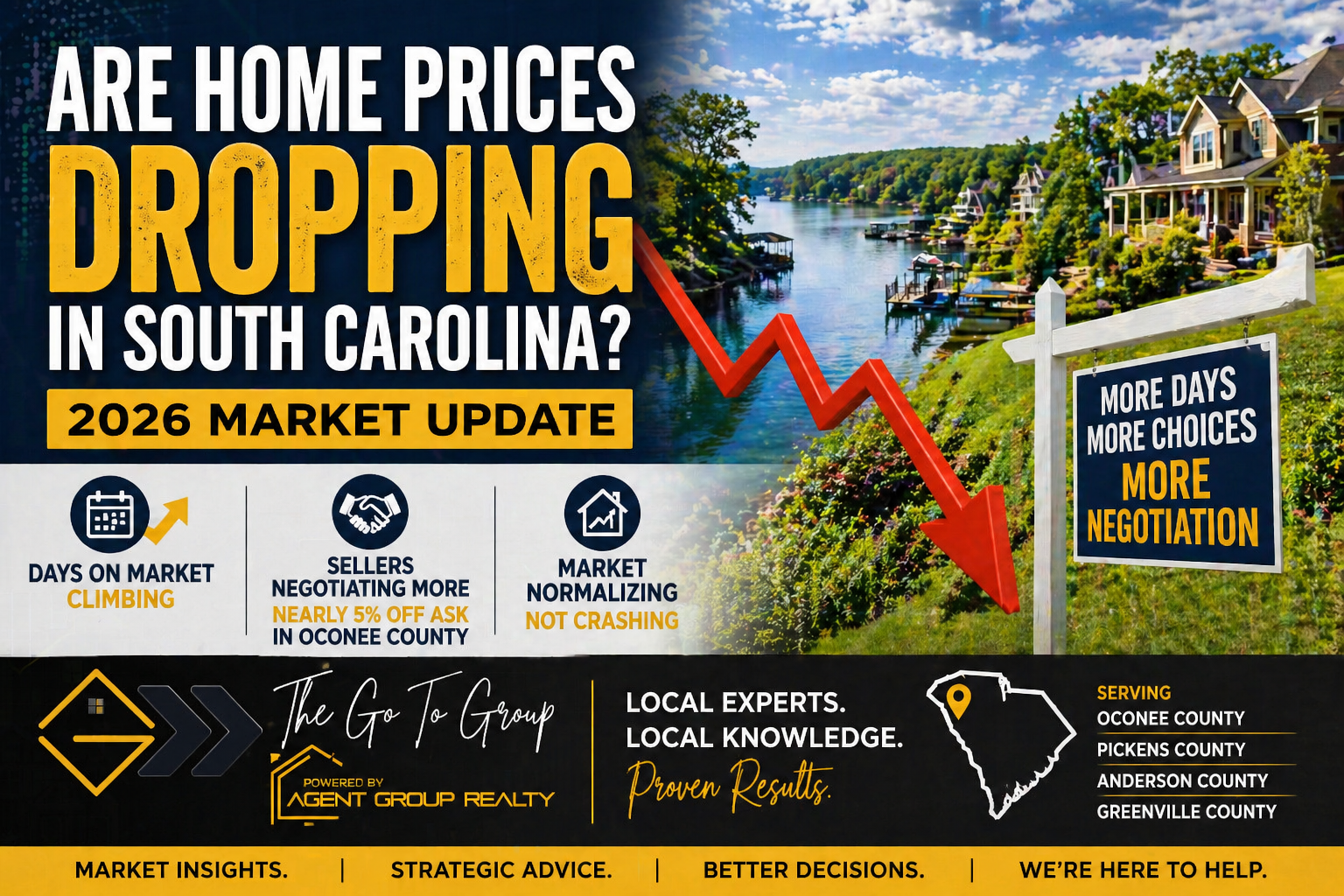
Are Home Prices Dropping in South Carolina?

Are Home Prices Dropping in South Carolina? Here’s What the Data Says in 2026

If you’ve been watching the housing market lately, you’re not alone in asking:

“Are home prices dropping in South Carolina?”

It’s one of the most searched real estate questions in 2026 — and the honest answer is:

Some markets are softening. Others are still rising. Most are simply normalizing.

South Carolina is not experiencing a broad housing crash. What we’re seeing instead is a more balanced market where buyers have more leverage, sellers need sharper pricing strategies, and homes are taking longer to sell.

Let’s break it down using current data — and more importantly, what we’re seeing right here in the Western Upstate of South Carolina.


South Carolina Home Prices: Flat to Slightly Down Statewide

According to Zillow’s latest statewide data, the average South Carolina home value is $300,562, which is down 0.2% year-over-year. Homes are also taking around 48 days to go pending, notably slower than the ultra-fast pace of recent years.

That tells us something important:

This isn’t a sharp drop — it’s a market correction toward normal conditions.

During 2020–2023, many markets saw unsustainable appreciation. In 2026, South Carolina appears to be settling into a healthier rhythm.


What’s Happening in the Upstate?

The Upstate continues to outperform many areas because of:

  • Population growth
  • Relative affordability
  • Strong employment corridors
  • Clemson University demand
  • Lifestyle migration toward lakes and mountains

Greenville County

Greenville remains one of the strongest markets in the state. Zillow reports the average home value at $327,592, up 2.2% year-over-year.

Anderson County

Anderson continues to benefit from proximity to Greenville, I-85 access, and Lake Hartwell demand.

Oconee County

Oconee is where we’re seeing one of the clearest examples of a more negotiable market.

Local trends indicate:

  • Days on market climbing
  • Sellers offering more concessions
  • Many homes closing around 5% below asking price
  • Buyers taking more time to make decisions

That doesn’t mean values are collapsing. It means buyers now have choices — and sellers must compete.

Pickens County

Pickens County remains desirable due to Clemson, mountain access, and commuter convenience. Well-priced homes still move, but overpriced listings are sitting longer than they did two years ago.


Lake Keowee, Hartwell & Lifestyle Markets

Lakefront markets behave differently than standard residential markets.

In areas around Lake Keowee and Lake Hartwell:

  • Waterfront inventory remains limited
  • Cash buyers are still active
  • Premium homes require strategic pricing
  • Buyers are negotiating harder than in 2021–2023

Luxury lake markets typically soften slower because demand is lifestyle-driven, not purely rate-driven.


Why Homes Are Taking Longer to Sell

Across South Carolina and locally, we’re seeing:

✔ More inventory
✔ Higher buyer expectations
✔ Mortgage rates still elevated vs pandemic lows
✔ Less emotional bidding wars
✔ More inspection and repair negotiations

That creates a healthier market — but one that rewards strategy.


So… Are Prices Dropping?

The Real Answer: Depends on Price Range & Location

In 2026:

  • Some entry-level homes are holding value well
  • Some move-up homes need price reductions
  • Some luxury homes are sitting longer
  • Prime locations still command premiums

The question isn’t simply “Are prices dropping?”

The better question is:

“How is my neighborhood performing right now?”

And that’s where local expertise matters.


What Sellers Need to Know Right Now

If you’re considering selling in the next 6–12 months:

1. Price Correctly from Day One

Today’s buyers are informed and cautious.

2. Condition Matters More Than Ever

Move-in ready homes often outperform dated homes.

3. Marketing Is Critical

Photos, video, reach, and presentation matter.

4. Be Open to Negotiation

Credits, repairs, and closing cost help are back.


Why The Go-To Group Matters

At The Go-To Group at Agent Group Realty, we know this market because we live it every day.

We understand the differences between:

  • Greenville suburban demand
  • Anderson value opportunities
  • Oconee lake & retirement buyers
  • Pickens / Clemson housing trends

Whether you're selling in Seneca, Clemson, Greenville, Anderson, Salem, or around Lake Keowee, we help clients price strategically and maximize results in today’s changing market.


Final Thoughts

No, South Carolina is not seeing a statewide housing crash.

Yes, some markets are softening.

And yes — the days of “name your price and sell in 24 hours” are mostly behind us.

This is a smarter market now.

That’s good news for buyers… and sellers who use the right strategy.


Thinking About Selling?

If you’d like to know what your home is worth today, what buyers are doing in your neighborhood, and how to win in this market:


📞 Reach out to The Go-To Group at Agent Group Realty. We’d be honored to help.

Posted in Market Updates
April 7, 2026

Best Real Estate Investment Platforms During Global Uncertainty (2026 Guide)

Which Real Estate Investment Platforms Perform Best During Global Uncertainty?

With ongoing geopolitical tensions, shifting economic policies, and global uncertainty making headlines in 2026, many investors are asking a very important question:

Where is the safest place to invest in real estate right now?

Historically, real estate has been viewed as a hard asset hedge during times of volatility. But not all real estate investments — or platforms — perform the same when markets get unpredictable.

Let’s break down what verified data and historical trends tell us, and how that applies to today’s environment — including opportunities right here in Upstate South Carolina.


Why Real Estate Gains Attention During Uncertain Times

Across multiple economic cycles — including the 2008 financial crisis, COVID-19 market volatility, and inflationary periods — real estate has consistently remained a preferred asset class for investors seeking stability.

Why?

  • Tangible asset (not just paper value)
  • Income-producing potential (rents)
  • Hedge against inflation
  • Lower volatility compared to equities in certain cycles

According to data from institutional investment reports and Federal Reserve tracking, capital often rotates into real assets (like real estate) when uncertainty rises globally.


Types of Real Estate Investment Platforms (And How They Perform)

Not all “platforms” are created equal — especially during geopolitical instability. Let’s break down the main categories investors are turning to:


1. Direct Real Estate Ownership (Most Resilient Long-Term)

This is the traditional model:

  • Buying residential homes
  • Rental properties
  • Vacation or lake homes

Performance during uncertainty:
Historically strong — especially in desirable lifestyle markets

Why it holds up:

  • Local demand remains consistent
  • Housing is a necessity
  • Investors can adjust rents or hold long-term

👉 Local Insight:
In markets like the Western Upstate of South Carolina, demand remains steady due to:

  • Lifestyle migration
  • Retirement relocation
  • University-driven housing (Clemson)

Properties around Lake Keowee and Lake Hartwell continue to attract cash-heavy buyers, even during slower cycles.


2. REITs (Real Estate Investment Trusts)

REITs allow investors to buy shares in real estate portfolios.

Performance during uncertainty:
Mixed — often tied to stock market volatility

  • Publicly traded REITs can drop quickly during global tension
  • However, sectors like residential and industrial REITs tend to perform better than retail or office

Key takeaway:
👉 REITs offer liquidity, but also expose investors to market swings


3. Real Estate Crowdfunding Platforms

Examples include platforms that allow fractional ownership in large deals.

Performance during uncertainty:

  • Varies widely depending on platform quality and asset type
  • Less liquid than stocks, but less volatile than public REITs

Risks to consider:

  • Platform stability
  • Deal structure
  • Exit timelines

These are often used by investors looking for passive exposure without direct ownership responsibilities.


4. Short-Term Rental / Vacation Property Platforms

This includes owning properties intended for Airbnb-style income.

Performance during uncertainty:

  • Strong in destination markets
  • Vulnerable if travel declines

👉 Local Tie-In:
The lakes region around Keowee, Hartwell, and Jocassee continues to perform well due to:

  • Regional tourism
  • Drive-to vacation demand
  • Limited inventory

However, investors need to evaluate:

  • Local regulations
  • Seasonality
  • Management costs

What the Data Suggests Right Now (2026)

Across multiple housing and investment reports:

  • Inventory is increasing → more buying opportunities
  • Mortgage rates stabilizing → improved predictability
  • Buyer competition lower than peak years
  • Cash buyers still dominant in luxury/lake markets

In South Carolina specifically:

  • A large percentage of homes are selling below list price
  • Days on market have increased
  • Negotiation leverage has returned to buyers

👉 This creates opportunity — especially for investors with patience and strategy.


So… What’s the “Best” Platform Right Now?

There’s no one-size-fits-all answer — but historically and currently:

Most Stable Choice:

✔ Direct ownership in strong local markets

Most Flexible Choice:

✔ REITs (with volatility trade-off)

Most Passive Choice:

✔ Crowdfunding platforms


Why Location Matters More Than Ever

During geopolitical uncertainty, investors tend to favor:

  • Domestic markets over international exposure
  • Lifestyle-driven regions
  • Areas with population growth

That’s exactly why markets like the Upstate of South Carolina continue to stand out.

Between:

  • Clemson University
  • Lake Keowee
  • Lake Hartwell
  • The Blue Ridge Mountains

…this region offers a combination of:
✔ Lifestyle appeal
✔ Long-term demand
✔ Relative affordability (compared to national luxury markets)


Where The Go-To Group Comes In

Understanding which platform to invest in is important.

But understanding where and how to execute that investment locally is where the real advantage lies.

At The Go-To Group with Agent Group Realty – Upstate, we help clients:

  • Identify high-opportunity properties
  • Analyze lake vs residential investments
  • Navigate negotiation in a shifting market
  • Understand long-term value vs short-term trends

We’ve worked with buyers ranging from:

  • First-time investors
  • Second-home purchasers
  • Luxury lakefront buyers

…and we’re seeing firsthand how 2026 is shaping up.


Final Thoughts

Global uncertainty doesn’t eliminate opportunity — it reshapes it.

The investors who tend to win in markets like this are the ones who:

  • Stay informed
  • Focus on fundamentals
  • Invest in strong locations
  • Work with local experts

Real estate remains one of the most proven long-term wealth-building tools, especially when approached strategically.


Thinking About Investing in 2026?

If you’re considering real estate — especially in the Upstate of South Carolina, Lake Keowee, or Lake Hartwell areas — let’s talk.

We’ll help you:
✔ Evaluate your options
✔ Understand the local market
✔ Build a strategy that aligns with your goals

📞 Connect with The Go-To Group at Agent Group Realty — and let’s make a smart move in today’s market.

Posted in Real Estate Tips
March 18, 2026

Is 2026 a Good Time to Buy a House in South Carolina?

Will 2026 Be a Good Time to Buy a Home?

A Data-Driven Look at the Market — With Insight from Upstate South Carolina

If you’ve been watching the housing market over the past few years, you’re not alone in asking:

“Will 2026 be a good time to buy a house?”

After a challenging stretch marked by high mortgage rates and low inventory, 2026 is shaping up to look… different. Not wildly better overnight — but more balanced, more predictable, and potentially more favorable for buyers than what we’ve seen recently.

Let’s break it down using real data — and then bring it home to what we’re seeing right here in the Upstate of South Carolina, especially around Lake Keowee, Lake Hartwell, and the surrounding communities.


The Big Picture: A Market Reset in 2026

Nationally, the housing market is coming out of one of its slowest periods in decades. In fact, existing home sales hovered near 30-year lows in 2025, largely due to affordability challenges and elevated interest rates.

But heading into 2026, the outlook is improving:

  • Mortgage rates are expected to stabilize around the 6%–6.3% range

  • Home sales are projected to increase, with forecasts reaching over 5 million transactions in 2026

  • Inventory is slowly rising, giving buyers more options and negotiating power

Even more encouraging — mortgage rates have already dipped close to 6% in early 2026, which has started to bring buyers back into the market.

Bottom line:
2026 isn’t a “boom” market — it’s a reset market.


What About South Carolina?

South Carolina continues to be one of the most desirable states for relocation — and that’s not slowing down.

Key data points:

  • Average home value: ~$300,562

  • Median sale price: ~$319,000

  • Median list price: ~$365,933

  • Roughly 71% of homes are selling below list price — signaling increased negotiation opportunities

That last point is important.

For buyers, it means:
👉 More leverage
👉 Less competition than peak years
👉 More room to negotiate price, repairs, and concessions


What We’re Seeing Locally: Upstate SC & The Lakes Region

Now let’s talk about what really matters — our backyard.

In Oconee County, a key hub for the Western Upstate:

  • Median sales price: $336,900

  • Average days on market: 79 days

  • Sale-to-list price ratio: 97.1%

This tells us:

  • Homes are still selling

  • But buyers are more selective

  • And negotiation is back in play


Lake Keowee & Lake Hartwell: A Unique Market

Lake markets behave differently — and right now, they’re telling an interesting story.

Lake Keowee (Luxury Market Snapshot)

  • Median sales price: $2,200,000

  • List-to-sold ratio: 98.2%

  • Inventory remains extremely limited

Even with slower activity:

  • Prices are still strong and rising

  • Buyers are more strategic, not gone

  • Well-positioned homes are still commanding strong numbers


What This Means for Buyers in Lake Markets

If you’re looking at Lake Keowee or Lake Hartwell, 2026 could offer:

✔ More inventory than the past few years
✔ Less emotional bidding wars
✔ More thoughtful negotiations

But don’t expect:
❌ Deep discounts
❌ “Crash” pricing
❌ Cheap waterfront opportunities

This is still a lifestyle-driven market — and those tend to hold value.


So… Is 2026 a Good Time to Buy?

The honest answer:

👉 Yes — but for different reasons than in the past.

In 2021–2022, buyers benefited from:

  • Ultra-low rates

  • Rapid appreciation

In 2026, buyers benefit from:

  • More inventory

  • More negotiation power

  • Less competition

  • Stabilizing rates

This creates something we haven’t seen in years:

A more balanced playing field.


Who Benefits Most in 2026?

The buyers who win in this market are:

  • Those who are prepared and pre-approved

  • Those who understand local market nuances

  • Those working with agents who can negotiate and identify value


Why Working With the Right Local Team Matters

Markets like the Western Upstate of South Carolina aren’t one-size-fits-all.

A home in:

  • Seneca near Lake Keowee

  • Clemson near the university

  • Pickens County in the mountains

…all behave differently.

At The Go-To Group with Agent Group Realty, we help buyers navigate:

  • Micro-market trends

  • Lake vs non-lake pricing strategies

  • Negotiation opportunities

  • Off-market and coming-soon opportunities

We’ve helped hundreds of families find “home” in this region, and 2026 is shaping up to be a year where strategy matters more than speed.


Final Thoughts

2026 is not about chasing the market.

It’s about understanding it.

If you’ve been waiting for:

  • Less competition

  • More options

  • A more reasonable pace

👉 This may be the window you’ve been looking for.


Thinking About Buying in 2026?

If you’re considering making a move in the Upstate of South Carolina — especially around Lake Keowee, Lake Hartwell, Seneca, or Clemson — let’s have a conversation.

We’ll help you:
✔ Understand your buying power
✔ Identify the right opportunities
✔ Build a strategy that works in today’s market

📞 Reach out to The Go-To Group at Agent Group Realty — we’re here to help you make the right move at the right time.

Posted in Real Estate Tips
March 8, 2026

Best Season to List in the Carolinas

When Is the Best Season to List Your Home in the Carolinas?

A Data-Driven Look for Sellers in the Upstate of South Carolina

If you’re thinking about selling your home in the next year, one of the most common questions homeowners ask is simple:

“When is the best time to list my home for sale?”

While every market has its own nuances, national housing data consistently shows that timing can influence how quickly your home sells and how strong your offers may be. For homeowners in the Southeastern United States — particularly the Carolinas — the seasonal trends are fairly consistent and worth understanding before you decide when to enter the market.

For sellers in the Western Upstate of South Carolina — including Oconee County, Pickens County, and the lakes and mountain region surrounding Lake Keowee, Lake Hartwell, and Lake Jocassee — timing your listing can be especially important because of the unique lifestyle drivers that attract buyers to this area.

Let’s unpack what the data tells us.


The Spring Market: Historically the Strongest Season for Sellers

Across the United States, spring consistently produces the highest level of buyer activity. According to research from the National Association of Realtors (NAR) and ATTOM Data Solutions, homes listed between March and May often sell faster and at slightly higher prices compared to other times of the year.

Several factors contribute to this:

• Families prefer to move during summer break before a new school year
• Warmer weather makes home shopping easier
• Homes typically show better with improved landscaping and natural light
• Buyers who paused during winter reenter the market

ATTOM’s nationwide housing analysis has found that May frequently produces the highest seller premiums, with homes selling for several percentage points above estimated market value on average.

For homeowners in the Upstate of South Carolina, the spring market also aligns with regional relocation cycles, particularly those tied to Clemson University, healthcare systems, and employers across the I-85 corridor.


Why the Carolinas Often See an Extended Selling Season

While spring is strong nationally, the Southeastern United States benefits from a longer active real estate season than colder regions.

Because winters in the Carolinas are relatively mild, the market often begins gaining momentum as early as late February and remains active through early fall.

For our local market around Seneca, Clemson, and the surrounding lake communities, this extended window is important. Many buyers relocating from northern states begin their home search months before they physically move, and they often target the Carolinas specifically for:

• Lower cost of living
• Outdoor lifestyle
• Proximity to lakes and mountains
• University towns like Clemson

This means that well-prepared listings can attract strong interest even before peak spring activity begins.


The Unique Influence of Lake and Lifestyle Buyers

Our local market is slightly different from traditional suburban markets because of the lifestyle-driven demand surrounding our lakes and mountains.

Communities around Lake Keowee, Lake Hartwell, and Lake Jocassee attract:

• retirees relocating from the Northeast and Midwest
• second-home buyers
• Clemson University alumni
• remote professionals seeking lifestyle destinations

Because of this, lake properties and homes in nearby communities such as Seneca, Salem, Six Mile, and Clemson often experience increased demand beginning in early spring and continuing through summer, when buyers visit the area and experience the lakes firsthand.

In many cases, waterfront homes show best when the lake activity is visible, making spring and summer particularly powerful listing windows.


What the Data Suggests for Sellers in the Upstate

While no two transactions are identical, most data-driven trends suggest that sellers often benefit from listing during the late winter to mid-spring window.

For many homes in our region, the optimal timing is typically:

Late February through May

This window allows sellers to:

• Capture early motivated buyers
• Benefit from peak spring demand
• Close transactions during summer relocation season

However, timing alone does not guarantee results.

Pricing strategy, marketing exposure, property preparation, and negotiation expertise often have a far greater impact on final outcomes than timing alone.


Why Local Expertise Still Matters More Than Timing

Real estate headlines often focus on national trends, but local market knowledge is what truly drives successful sales.

The Western Upstate market has its own rhythms influenced by:

• Clemson University’s academic calendar
• regional job growth
• lake and second-home demand
• seasonal tourism in the mountains and lakes

At Agent Group Realty, and specifically within our enhanced service tier The Go-To Group, our team works closely with sellers to evaluate not just seasonal trends but also micro-market conditions within specific communities.

The strategy for a home in Seneca near Lake Keowee, for example, may look very different from a home in Pickens or a property closer to Clemson’s campus.


Thinking About Selling in the Next Year?

If selling your home is on your radar within the next 6–12 months, now is the right time to begin planning, even if you’re not ready to list immediately.

Preparation steps such as:

• evaluating market value
• identifying strategic improvements
• timing your listing with market momentum
• preparing professional marketing assets

can all significantly influence your final result.

The earlier sellers begin planning, the more options they typically have.


Final Thoughts

For homeowners in the Upstate of South Carolina’s lakes and mountain region, the best time to list a home is often late winter through spring, when buyer activity begins rising and continues into the summer relocation season.

But the truth is this:

The best time to sell is when preparation, pricing strategy, and market timing align with your personal goals.

At The Go-To Group at Agent Group Realty, we help homeowners throughout Oconee County, Pickens County, and the Lake Keowee and Lake Hartwell communities navigate these decisions with clear data, thoughtful strategy, and local expertise.

If you’re considering selling in the coming year and want to understand what timing might look like for your home specifically, we’re always happy to have that conversation.


Considering Selling Your Home?


Reach out to The Go-To Group at Agent Group Realty to discuss your property, current market trends, and the best strategy for maximizing your sale.


Posted in Real Estate Tips
Feb. 2, 2026

Where to Invest in Vacation Rentals in 2026

Where to Invest in Vacation Rentals in 2026: High Returns & Year-Round Demand

The Vacation Rental Market Shift: 2025–2026 Trends

The vacation rental landscape is changing. While glamorous, coastal hotspots dominated past years, 2025–2026 is all about high-yield mid-sized cities and consistent regional hubs. Investors are finding that lower entry prices paired with steady demand often outperform flashy, saturated destinations.


Whether you’re looking for strong annual income, year-round occupancy, or emerging markets with growth potential, knowing where to invest can make all the difference. Here’s a breakdown of the hottest vacation rental markets heading into 2026.

1. Top High-Yield Investment Markets (2026 Projections)

Data from AirDNA’s 2026 Outlook highlights cities offering yields of 12%+, driven by low property prices and consistent demand from business travelers, military personnel, and regional tourism:

  • Port Arthur & Abilene, TX – Yields as high as 14–16%. Demand comes from major energy projects, Dyess AFB, and “bleisure” travel.

  • Charleston, WV – Low buy-in price (~$228,000) with a 14.1% yield, making it an attractive option for investors.

  • Springfield, IL – Recognized by Lodgify for its 8.02% cap rate and stable government-related rental demand.

  • Akron, OH & Peoria, IL – High occupancy thanks to healthcare and university travel, with low entry costs for new investors.

For those seeking strong ROI without the premium price tag, these high-yield markets are worth exploring.


2. Top “Traditional” Vacation Markets (2025 Rankings)

If your goal is established vacation rental destinations, Vacasa’s 2025 report ranks markets based on capitalization rate (net income vs. home price):

  • North Myrtle Beach, SC – #1 for 2025 due to strong annual revenue and irresistible beach appeal.

  • Dauphin Island, AL – A small-town coastal gem with strong seasonal performance.

  • Gatlinburg/Pigeon Forge, TN – Year-round mountain market near the Great Smoky Mountains.

  • Hatteras Island & North Topsail Beach, NC – Emerging coastal options offering higher ROI than Florida’s crowded markets.

These destinations provide a balance of predictable revenue and lifestyle appeal.


3. Year-Round & Emerging “Goldilocks” Markets

Some investors prioritize steady occupancy over seasonal peaks, seeking consistent cash flow without the winter slump:

  • Year-Round Stability: Oahu, HI and Lafayette, LA maintain nearly flat occupancy curves, ensuring steady rental income throughout the year.

  • Emerging Hubs: Winter Haven, FL (near Legoland) and Davenport, FL (near Disney) are “goldilocks” markets with strong demand growth and affordable housing.

Investor Tip: Steer clear of markets with heavy regulations like New York, San Francisco, and Nashville. Higher entry prices and stricter short-term rental laws can reduce overall ROI.


Why Partner with Local Experts Matters

Investing in vacation rentals, especially in the Lakes and Mountains region of Upstate South Carolina, requires a trusted local partner. That’s where Robert Whitesides with Agent Group Realty and The Go-To Group (Emma, Matt, Courtney) come in.

We specialize in:

  • Lakefront and mountain properties ideal for vacation rentals

  • Market analysis to maximize ROI

  • Handling the complexities of property management and local regulations

  • Guiding buyers through the purchase process from start to finish

Whether you’re looking for a high-yield city investment or a charming mountain retreat, we can help you find the property that fits your goals.


Ready to Invest in Your Next Vacation Rental?

The 2025–2026 markets present a range of opportunities—from high-yield mid-sized cities to traditional beach towns and year-round “goldilocks” hubs.

If you’re considering real estate investment in South Carolina or beyond, connect with Robert Whitesides and The Go-To Group. We’ll help you identify the best properties, analyze projected returns, and navigate local regulations so your vacation rental investment is profitable and stress-free.

📞 Contact us today to explore vacation rental opportunities in the Lakes & Mountains region of Upstate SC. Your next investment is waiting.

Posted in Real Estate Tips