


Is the Real Estate Market Dead?
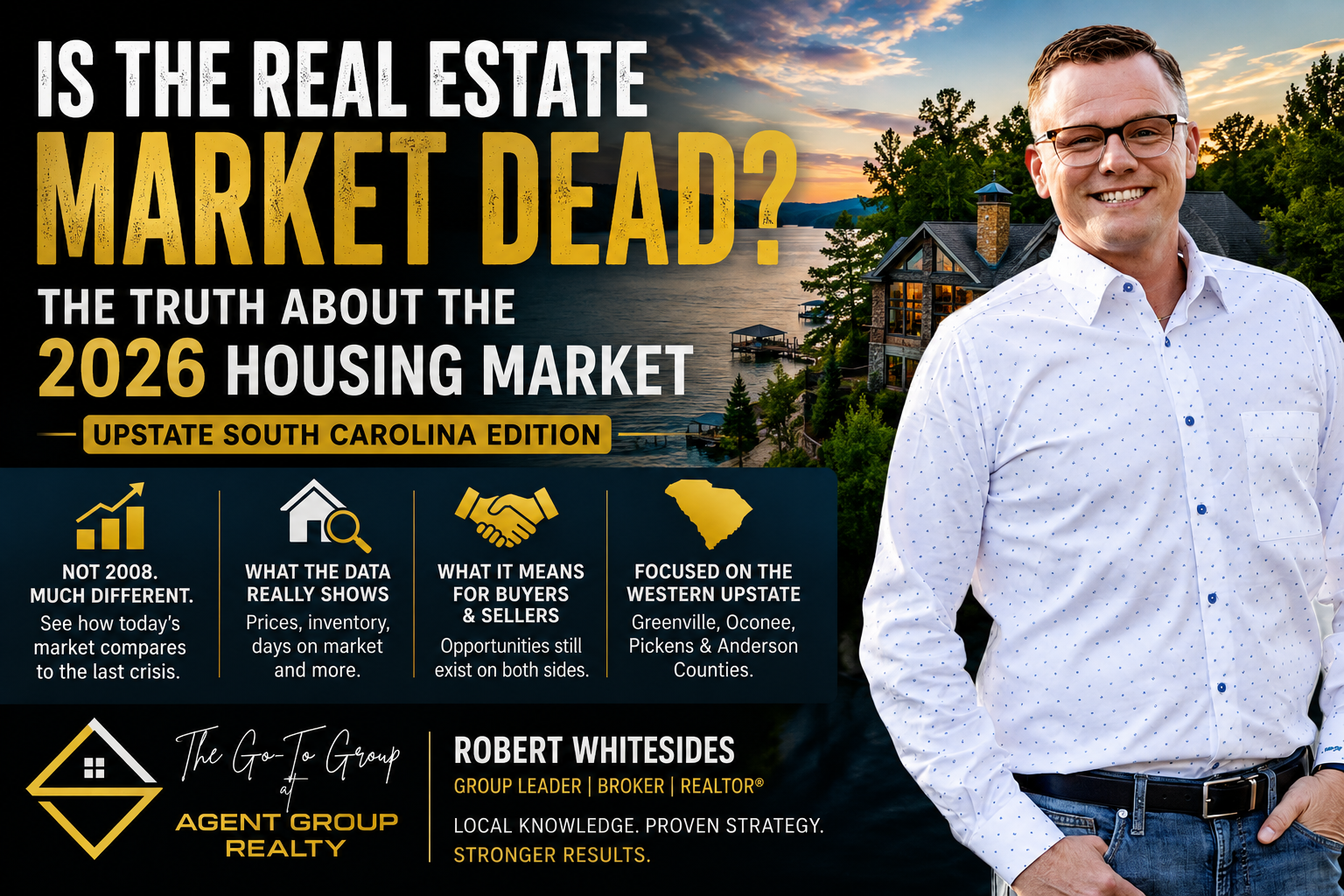
If you've talked to enough people about real estate lately, you've probably heard some version of it:
"The market is dead."
"Nobody is buying."
"Everything is frozen."
"I'm just going to wait until things get better."
I understand where those comments are coming from.
The 2026 housing market has been frustrating for buyers, sellers, real estate professionals, builders and lenders alike. Mortgage rates remain elevated, affordability is difficult, homes are taking longer to sell, and buyers have become much more selective.
But here's the important distinction:
The real estate market isn't dead. It's slower, more expensive to finance, and much more negotiable than it was a few years ago.
And that's a very different story.
As a REALTOR® working every day in the Western Upstate of South Carolina, I believe it's important to look at the actual numbers—not the headlines.
The 2026 Housing Market Is Definitely Slower
Let's start by acknowledging the obvious.
This is not a booming housing market.
The National Association of REALTORS® reported that existing-home sales in July 2026 were running at a seasonally adjusted annual rate of 4.06 million, down 1.7% from June but still 0.7% higher than July 2025.
The median existing single-family home price was $440,300, up 1.9% from a year earlier.
There were approximately 1.54 million homes in inventory, representing about 4.6 months of supply.
So are fewer people buying homes?
Yes.
Are people still buying homes?
Absolutely.
That's an important distinction.
Mortgage Rates Are Still a Big Part of the Story
It's difficult to talk about the current housing market without talking about interest rates.
As of August 20, 2026, Freddie Mac's Primary Mortgage Market Survey showed the average 30-year fixed mortgage rate at 6.65%.
That's down slightly from 6.67% the previous week—but still considerably higher than the rates many homeowners locked in during 2020–2021.
This creates a problem that didn't exist in quite the same way during the last housing cycle.
Millions of homeowners have mortgages with historically low interest rates.
If they sell, they may be giving up a 3% or 4% mortgage and replacing it with something closer to today's 6%–7% environment.
That's one reason inventory and transaction volume can remain constrained even when there are plenty of people who would like to move.
What We're Seeing in the Western Upstate
Now let's bring this home.
Because South Carolina isn't the United States, and Greenville isn't Oconee County.
The Western Upstate has its own story.
The latest county-level data from Realtor.com shows just how different the individual markets can be.
Oconee County
As of the latest available county market report, Oconee County had a median listing price of approximately $457,950 and a median sold price of $438,500.
The median days on market was 58 days, up 6.86% year over year.
Interestingly, the median sold price was reported 15.55% higher than the prior year, while homes sold for approximately 98% of asking price on average.
That's not a dead market.
That's a market where buyers have negotiating power.
Pickens County
Pickens County showed a median listing price around $422,393 and a median sold price of $318,000.
The county had approximately 1,155 homes for sale, with median days on market around 57 days.
Homes sold for approximately 99% of asking price, and the county was characterized as a balanced market.
Again—slow?
Yes.
Dead?
No.
Anderson County
Anderson County's latest available data shows a median listing price around $349,000, with approximately 2,100 homes available.
The median sold price was about $299,995, and the median days on market was 52 days in the June report. More recent August data shows average days on market around 64 days.
That tells me buyers are taking their time.
They're negotiating.
They're shopping.
But they're still buying.
Greenville County
Greenville County remains one of the largest and most active housing markets in our region.
August 2026 data shows approximately 4,884 active listings, with median days on market around 57 days.
Inventory was up 11.12% year over year, while the median listing price was approximately $412,425.
The median sold price was about $370,000, down 2.61% from the previous year.
That's a cooling market.
It isn't a collapse.
This Is NOT 2008
This is probably the most important part of this article.
I was in the real estate business during the last major housing crisis, and what we're experiencing today is fundamentally different from what happened between 2008 and 2011.
The distinction matters.
In 2008, housing was part of the problem.
Today, housing is largely dealing with an affordability and transaction problem.
During the financial crisis, loose mortgage underwriting, risky mortgage products, rapidly rising defaults and foreclosures helped create a massive supply of distressed properties.
The Federal Reserve documented how declining home prices and loosened underwriting standards contributed to sharp increases in mortgage delinquencies and foreclosures.
Research from the National Bureau of Economic Research also documented the enormous role that foreclosures played in the housing downturn.
And the national home-price data shows just how severe that correction was.
The S&P Cotality Case-Shiller national index peaked around 184.6 in July 2006.
By early 2012, it had fallen to approximately 134.
That's roughly a 27% decline from the peak to the trough in the national index.
That's a housing crash.
What we're experiencing today doesn't look like that.
Today's Homeowner Is In a Very Different Position
One of the biggest differences is homeowner equity.
Many homeowners today have substantial equity in their properties because of the appreciation we've experienced over the last decade.
The Federal Reserve Bank of New York reported approximately $13.1 trillion in U.S. mortgage balances at the end of Q2 2026, while overall household debt remained relatively stable.
And mortgage delinquency remains nowhere near the kind of systemic crisis associated with 2008.
The Federal Reserve's latest data shows the delinquency rate on single-family residential mortgages held by commercial banks at approximately 1.86% in Q2 2026.
That doesn't mean every homeowner is financially comfortable.
It certainly doesn't mean there aren't people struggling.
But it does mean we're not looking at the same broad-based mortgage distress that helped fuel the 2008 housing collapse.
So Why Does the Market FEEL Frozen?
This is where I think the word "frozen" actually makes some sense.
The market has become a transactional traffic jam.
Think about it.
A homeowner has a 3.25% mortgage.
They'd like to move.
But replacing that mortgage with a 6.65% mortgage may dramatically increase their monthly payment.
So they stay put.
A buyer wants to purchase.
But that buyer is struggling with affordability at today's prices and interest rates.
So they wait.
The seller doesn't want to reduce the price.
The buyer doesn't want to overpay.
And the transaction doesn't happen.
That's a frozen market.
But frozen doesn't mean broken.
Real Estate Has Always Had Ups and Downs
This is something I remind my clients often:
Real estate has never gone straight up.
There have always been cycles.
Booms.
Corrections.
Recessions.
Interest-rate changes.
Inventory shortages.
Overbuilding.
Underbuilding.
Economic expansions.
Economic contractions.
And yet, over long periods of time, residential real estate has historically appreciated.
The FHFA House Price Index provides some pretty compelling perspective.
As of Q2 2026, South Carolina's FHFA purchase-only house price index was:
- Up 2.38% over one year
- Up 45.39% over five years
- Up approximately 350% since 1991
The national FHFA index was up approximately 335.69% since 1991.
That doesn't mean every house appreciates every year.
It doesn't mean you can't lose money on real estate.
And it certainly doesn't mean you should buy a property simply because "real estate always goes up."
But it does demonstrate something important:
Historically, time has been one of the most powerful advantages a homeowner can have.
What Does This Mean for Buyers?
If you're a buyer in today's market, there are actually some opportunities that didn't exist during the frenzy of 2020–2022.
You may have:
- More homes to choose from
- More time to make a decision
- More negotiating leverage
- More opportunity to request repairs
- More opportunity to negotiate price
- Less pressure to waive important contingencies
That's meaningful.
The tradeoff?
Money is still expensive to borrow.
So buyers need to focus less on predicting the absolute bottom of the market and more on whether the specific property, payment and long-term plan make sense.
What Does This Mean for Sellers?
Sellers have a different challenge.
The days of putting a house on the MLS on Friday and having 15 offers by Sunday are not the norm in today's market.
Pricing matters.
Condition matters.
Presentation matters.
Marketing matters.
And patience matters.
If you're selling in Oconee County, Pickens County, Anderson County, Greenville County, Seneca, Clemson, Lake Keowee or Lake Hartwell, your strategy needs to reflect what buyers are actually doing—not what they were doing three years ago.
The Western Upstate Is Still a Special Place to Own Real Estate
There's another piece of the equation that I don't think we should overlook.
People aren't moving to the Western Upstate simply because of a spreadsheet.
They're moving here because of the lifestyle.
Lake Keowee.
Lake Hartwell.
Lake Jocassee.
The Blue Ridge Mountains.
Clemson University.
Outdoor recreation.
Healthcare.
Small-town communities.
Greenville's growth.
And the quality of life throughout Oconee, Pickens and Anderson Counties.
South Carolina's population has grown significantly since 2020. Census estimates show the state population increased approximately 8.8% from April 2020 through July 2025.
That underlying population growth is one of the reasons I remain optimistic about the long-term fundamentals of this part of South Carolina.
My Take as a Western Upstate REALTOR®
I'll be the first to tell you:
This isn't the easiest real estate market I've ever worked in.
It's not.
But I also don't believe the sky is falling.
I believe we're in a period of normalization.
The market is forcing buyers and sellers to have more realistic conversations.
Sellers can't simply name a price and expect the market to validate it.
Buyers can't assume every property is going to be 20% below asking price.
And REALTORS® have to earn their keep.
That last part is important.
This market requires professionals who understand pricing, negotiation, marketing, financing, inventory and local market behavior.
That's where experience matters.
Where The Go-To Group Comes In
I'm Robert Whitesides, Group Lead of The Go-To Group at Agent Group Realty, and I've spent years helping buyers and sellers navigate the Upstate of South Carolina.
Our team includes Courtney Gambrell, Matt Oliver and Emma Massey, and together we're focused on the communities we know best.
From Greenville and Anderson to Pickens and Oconee County—and from Clemson and Seneca to Lake Keowee and Lake Hartwell—we understand that every neighborhood and every transaction tells a slightly different story.
We're not here to tell you the market is perfect.
We're not here to tell you a crash is coming.
And we're certainly not here to make a decision for you.
We're here to give you the information you need to make a good decision.
Whether you're thinking about buying, selling, investing, moving up, downsizing or simply trying to figure out what your options are, we'd be happy to have a conversation.

Final Thoughts: Dead or Different?
So, is the real estate market dead?
No.
Is it slower?
Absolutely.
Is it frustrating?
For plenty of buyers and sellers, yes.
Is it more negotiable?
Without question.
Is it the same as 2008?
Not even close.
Today's market is being shaped primarily by affordability, mortgage rates, limited mobility and a mismatch between what buyers can afford and what sellers are willing to accept.
That's a challenge.
But challenges create opportunities, too.
And if history teaches us anything, it's that real estate markets move in cycles.
The market changes. The headlines change. Interest rates change. Buyer behavior changes.
But well-located real estate in desirable communities has historically rewarded people who think in years rather than weeks.
That's especially worth remembering here in the Western Upstate of South Carolina.
The market isn't dead.
It's different.
And different requires a different strategy.
Sources & Data Notes
This article relies primarily on non-sponsored public data and research, including the National Association of REALTORS®, Federal Housing Finance Agency, Federal Reserve Bank of St. Louis/FRED, Federal Reserve Bank of New York, Freddie Mac, U.S. Census Bureau, National Bureau of Economic Research and current Realtor.com Economic Research county-level market data. Local market figures are identified by their reporting period because county-level datasets do not all update on the same schedule.